Workday-Pro-Integrations Exam Success & Workday-Pro-Integrations Exam Papers
Wiki Article
DOWNLOAD the newest Actual4test Workday-Pro-Integrations copyright from Cloud Storage for free: https://drive.google.com/open?id=1UJhYst8fojA1IbTw5MC1BPWEGMDSMF9a
Our Workday Workday-Pro-Integrations exam questions are designed to provide you with the most realistic Workday-Pro-Integrations experience possible. Each question is accompanied by an accurate answer, prepared by our team of experts. We also offer free Workday Workday-Pro-Integrations Exam Questions updates for 1 year after purchase, as well as a free Workday-Pro-Integrations practice exam questions demo before purchase.
Workday Workday-Pro-Integrations Exam Syllabus Topics:
| Topic | Details |
|---|---|
| Topic 1 |
|
| Topic 2 |
|
| Topic 3 |
|
>> Workday-Pro-Integrations Exam Success <<
Actual4test Workday Workday-Pro-Integrations Desktop-based Practice Test Software
Our Workday-Pro-Integrations exam materials have plenty of advantages. For example, in order to meet the needs of different groups of people, we provide customers with three different versions of Workday-Pro-Integrations actual exam, which contain the same questions and answers. They are the versions of the PDF, Software and APP online. You can choose the one which is your best suit of our Workday-Pro-Integrations Study Materials according to your study habits.
Workday Pro Integrations Certification Exam Sample Questions (Q53-Q58):
NEW QUESTION # 53
Refer to the following scenario to answer the question below.
You need to configure a Core Connector: Candidate Outbound integration for your vendor. The connector requires the data initialization service (DIS).
The vendor requests additional formatting of the candidate Country field. For example, if a candidate's country is the United States of America, the output should show USA.
What steps do you follow to meet this request?
- A. Use the integration services to only output shortened country codes.
- B. Use the integration related action Configure Integration Population Eligibility.
- C. Use an Evaluated Expression calculation and add it to the integration's report data source.
- D. Use the integration related action Configure Integration Maps.
Answer: D
Explanation:
The scenario involves a Core Connector: Candidate Outbound integration with the Data Initialization Service (DIS), where the vendor requires the "Country" field to be formatted differently (e.g., "United States of America" to "USA"). This is a data transformation requirement, and Core Connectors provide specific tools to handle such formatting. Let's evaluate the solution:
* Requirement:The vendor needs a shortened country code (e.g., "USA" instead of "United States of America") in the output file. This involves transforming the delivered "Country" field value from the Candidate business object into a vendor-specific format.
* Integration Maps:In Workday Core Connectors, integration maps are used to transform or map field values from Workday's format to a vendor's required format. For example, you can create a map that replaces "United States of America" with "USA," "Canada" with "CAN," etc. This is configured via the
"Configure Integration Maps" related action on the integration system, allowing you to define a lookup table or rule-based transformation for the Country field.
* Option Analysis:
* A. Use an Evaluated Expression calculation and add it to the integration's report data source:
Incorrect. While an Evaluate Expression calculated field could transform the value (e.g., if-then logic), Core Connectors don't directly use report data sources for output formatting. Calculated fields are better suited for custom reports or EIBs, not Core Connector field mapping.
* B. Use the integration related action Configure Integration Population Eligibility: Incorrect. This action filters the population of candidates included (e.g., based on eligibility criteria), not the formatting of individual fields like Country.
* C. Use the integration services to only output shortened country codes: Incorrect. Integration services define the dataset or events triggering the integration, not field-level formatting or transformations.
* D. Use the integration related action Configure Integration Maps: Correct. Integration maps are the standard Core Connector tool for transforming field values (e.g., mapping "United States of America" to "USA") to meet vendor requirements.
* Implementation:
* Navigate to the Core Connector: Candidate Outbound integration system.
* Use the related action Configure Integration Maps.
* Create a new map for the "Country" field (e.g., Source Value: "United States of America," Target Value: "USA").
* Apply the map to the Country field in the integration output.
* Test the output file to ensure the transformed value (e.g., "USA") appears correctly.
References from Workday Pro Integrations Study Guide:
* Core Connectors & Document Transformation: Section on "Configuring Integration Maps" details how to transform field values for vendor-specific formatting.
* Integration System Fundamentals: Explains how Core Connectors handle data transformation through maps rather than calculated fields or services for field-level changes.
NEW QUESTION # 54
You are creating an outbound connector using the Core Connector: Organization Outbound template. The vendor has provided the following requirements for how the data should appear in the output file.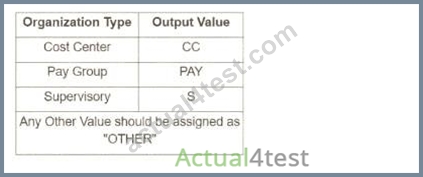
The vendor would also like to change the default document retention policy of 30 days to 7 days. What tasks do you need to use to configure this in your connector?
- A. Configure Integration Maps and Configure Integration Field Attributes
- B. Configure Integration Field Overrides and Configure Integration Attributes
- C. Configure Integration Field Overrides and Configure Integration Field Attributes
- D. Configure Integration Maps and Configure Integration Attributes
Answer: B
Explanation:
When creating an outbound connector using the Workday Core Connector: Organization Outbound template, you need to configure the connector to meet specific vendor requirements, such as formatting output data and adjusting document retention policies. Let's break down the question and analyze the requirements and options based on Workday's integration framework, specifically focusing on the Core Connector and its configuration tasks.
Understanding the Requirements
* Output Data Formatting:The vendor has provided a table specifying how organization types should appear in the output file (e.g., Cost Center as "CC", Pay Group as "PAY", Supervisory as "S", and any other value as "OTHER"). This indicates a need to transform or map Workday organization data into specific output values, which is typically handled by configuring how fields are processed or mapped in the integration.
* Document Retention Policy Change:The vendor wants to change the default document retention policy from 30 days to 7 days. In Workday, document retention policies for integrations (e.g., files stored on SFTP or other delivery methods) are managed through integration settings, specifically attributes related to file retention or delivery options.
Analyzing Workday Core Connector: Organization Outbound
The Core Connector: Organization Outbound template is a pre-built Workday integration template used to extract organization-related data (e.g., cost centers, pay groups, supervisory organizations) and send it to an external system. It leverages Workday's integration framework, including integration maps, field overrides, and attributes, to customize data output and behavior.
* Integration Maps: Used to define how data is transformed or mapped from Workday to the output format, often involving XSLT or predefined mappings.
* Integration Field Overrides: Allow you to override or customize how specific fields are displayed or formatted in the output, such as mapping "Cost Center" to "CC" as per the vendor's table.
* Integration Attributes: Control broader integration settings, such as delivery methods, file formats, and retention policies (e.g., document retention duration).
* Integration Field Attributes: Typically focus on specific field-level properties but are less commonly used for retention policies or broad mappings compared to the above options.
Evaluating the Vendor's Output Requirements
The table provided (Cost Center # "CC", Pay Group # "PAY", Supervisory # "S", any other value #
"OTHER") suggests a need to transform or override the default output values for organization types. This is a field-level customization, best handled by Integration Field Overrides, which allow you to specify custom values or formats for specific fields in the output.
* For example, in the Core Connector, you can use Integration Field Overrides to map the Workday organization type (e.g., "Cost_Center") to the vendor's desired output ("CC"). This is a common practice for outbound integrations where external systems require specific formatting.
Evaluating the Retention Policy Change
The default document retention policy of 30 days needs to be changed to 7 days. In Workday, retention policies for integration output files (e.g., files delivered via SFTP or email) are configured as part of the integration's attributes, not field-level settings.
* Integration Attributes are used to manage integration-wide settings, including delivery options, file retention periods, and other global configurations. You can specify the retention period (e.g., 7 days) in the attributes section of the Core Connector configuration.
* This is distinct from field-level overrides or maps, as retention is not tied to individual data fields but to the integration's output management.
Analyzing the Options
Now, let's evaluate each option to determine which tasks are needed to meet both requirements:
* A. Configure Integration Maps and Configure Integration Attributes
* Integration Maps: These are used for broader data transformations or mappings, such as converting Workday XML to another format or defining complex data relationships. While they could theoretically handle the output value mappings (e.g., Cost Center # "CC"), they are typically more complex and less granular than field overrides for simple value changes.
* Integration Attributes: Correct for configuring the retention policy (e.g., changing from 30 to 7 days), as attributes manage integration-wide settings like retention.
* Why Not Sufficient?: Integration Maps are overkill for simple field value overrides like the vendor's table, and field-level customization is better handled by Integration Field Overrides for precision and ease.
* B. Configure Integration Field Overrides and Configure Integration Field Attributes
* Integration Field Overrides: Correct for mapping specific field values (e.g., Cost Center # "CC"), as they allow granular control over output formats for individual fields.
* Integration Field Attributes: These are less commonly used and typically focus on field-specific properties (e.g., data type, length), not broad integration settings like retention policies. Retention is not managed at the field level, so this is incorrect for the retention requirement.
* Why Not Sufficient?: Integration Field Attributes do not handle retention policies, making this option incomplete.
* C. Configure Integration Field Overrides and Configure Integration Attributes
* Integration Field Overrides: Perfect for mapping the vendor's output values (e.g., Cost Center #
"CC", Pay Group # "PAY", etc.), as they allow precise control over field-level output formatting.
* Integration Attributes: Correct for configuring the retention policy (e.g., changing from 30 to 7 days), as attributes manage integration-wide settings like file retention.
* Why Sufficient?: This combination addresses both requirements-field-level output formatting and integration-wide retention policy changes-making it the most accurate choice.
* D. Configure Integration Maps and Configure Integration Field Attributes
* Integration Maps: As explained, these are better for complex transformations, not simple field value overrides like the vendor's table. They could work but are less efficient than field overrides.
* Integration Field Attributes: As noted, these do not handle retention policies or broad integration settings, making them incorrect for the retention requirement.
* Why Not Sufficient?: This combination fails to address retention effectively and uses Integration Maps when Integration Field Overrides would be more appropriate for the output formatting.
Conclusion
Based on the analysis, the vendor's requirements for output formatting (mapping organization types to specific values) and changing the retention policy (from 30 to 7 days) are best met by:
* Integration Field Overrides: To customize the output values for organization types (e.g., Cost Center #
"CC") as shown in the table.
* Integration Attributes: To adjust the document retention policy from 30 days to 7 days.
NEW QUESTION # 55
Refer to the following scenario to answer the question below.
You have configured a Core Connector: Worker integration, which utilizes the following basic configuration:
* Integration field attributes are configured to output the Position Title and Business Title fields from the Position Data section.
* Integration Population Eligibility uses the field Is Manager which returns true if the worker holds a manager role.
* Transaction Log service has been configured to Subscribe to specific Transaction Types: Position Edit Event.
You launch your integration with the following date launch parameters (Date format of MM/DD/YYYY):
* As of Entry Moment: 05/25/2024 12:00:00 AM
* Effective Date: 05/25/2024
* Last Successful As of Entry Moment: 05/23/2024 12:00:00 AM
* Last Successful Effective Date: 05/23/2024
To test your integration, you made a change to a worker named Jeff Gordon who is not assigned to the manager role. You perform an Edit Position on Jeff Gordon and update their business title to a new value. Jeff Gordon's worker history shows the Edit Position Event as being successfully completed with an effective date of 05/24/2024 and an Entry Moment of 05/24/2024 07:58:53 AM however Jeff Gordon does not show up in your output.
What configuration element would have to be modified for the integration to include Jeff Gordon in the output?
- A. Integration Field Attributes
- B. Transaction log subscription
- C. Date launch parameters
- D. Integration Population Eligibility
Answer: D
Explanation:
The scenario describes a Core Connector: Worker integration with specific configurations, and a test case where Jeff Gordon's data doesn't appear in the output despite an Edit Position event. Let's analyze why Jeff Gordon is excluded and what needs to change:
* Current Configuration:
* Integration Field Attributes: Outputs Position Title and Business Title from Position Data.
* Integration Population Eligibility: Filters workers where "Is Manager" = True (only managers).
* Transaction Log Service: Subscribes to "Position Edit Event" transactions.
* Launch Parameters:
* As of Entry Moment: 05/25/2024 12:00:00 AM
* Effective Date: 05/25/2024
* Last Successful As of Entry Moment: 05/23/2024 12:00:00 AM
* Last Successful Effective Date: 05/23/2024
* Test Case:
* Worker: Jeff Gordon (not a manager).
* Action: Edit Position, updating Business Title.
* Event Details: Effective Date 05/24/2024, Entry Moment 05/24/2024 07:58:53 AM.
* Result: Jeff Gordon does not appear in the output.
* Analysis:
* Date Parameters: The integration captures changes between the Last Successful As of Entry Moment (05/23/2024 12:00:00 AM) and the current As of Entry Moment (05/25/2024 12:00:00 AM). Jeff's Edit Position event (Entry Moment 05/24/2024 07:58:53 AM) falls within this range, and its Effective Date (05/24/2024) is before the integration's Effective Date (05/25/2024), making it eligible from a date perspective.
* Transaction Log: Subscribed to "Position Edit Event," which matches Jeff's action (Edit Position), so the event type is correctly captured.
* Field Attributes: Outputs Position Title and Business Title, and Jeff's update to Business Title aligns with these fields.
* Population Eligibility: Filters for "Is Manager" = True. Jeff Gordon is explicitly noted as "not assigned to the manager role," meaning "Is Manager" = False for him. This filter excludes Jeff from the population, regardless of the event or date eligibility.
* Why Jeff is Excluded:TheIntegration Population Eligibilityrestriction ("Is Manager" = True) prevents Jeff Gordon from being included, as he isn't a manager. This filter applies to the entire worker population before events or fields are considered, overriding other conditions.
* Option Analysis:
* A. Transaction Log Subscription: Incorrect. The subscription already includes "Position Edit Event," which matches Jeff's action. Modifying this wouldn't address the population filter.
* B. Integration Population Eligibility: Correct. Changing this to include non-managers (e.g., removing the "Is Manager" = True filter or adjusting it to include all employees) would allow Jeff Gordon to appear in the output.
* C. Date Launch Parameters: Incorrect. Jeff's event (05/24/2024) falls within the date range, so the parameters are not the issue.
* D. Integration Field Attributes: Incorrect. The attributes already include Business Title, which Jeff updated, so this configuration is irrelevant to his exclusion.
* Modification Needed:Adjust theIntegration Population Eligibilityto either:
* Remove the "Is Manager" = True filter to include all workers, or
* Modify it to align with the scenario's intent (e.g., "Worker Type equals Employee") if managers were an unintended restriction.
* Implementation:
* Edit the Core Connector: Worker integration.
* Use the related actionConfigure Integration Population Eligibility.
* Remove or adjust the "Is Manager" = True condition.
* Relaunch the integration and verify Jeff Gordon appears in the output.
References from Workday Pro Integrations Study Guide:
* Core Connectors & Document Transformation: Section on "Configuring Integration Population Eligibility" explains how eligibility filters the worker population before event processing.
* Integration System Fundamentals: Details how population scoping interacts with event subscriptions and launch parameters.
NEW QUESTION # 56
Refer to the scenario. You are configuring a Core Connector: Worker integration to extract worker demographic and contact information. The integration uses the Data Initialization Service (DIS) and must include worker fields such as name, address, and a calculated field identifying workers eligible for a phone allowance.
During a Full File test run, the output file is missing all address-related information, even though the Address Line Data, Municipality, Region, and Postal Code fields were configured in the Configure Integration Field Attributes step. You also confirmed that the Worker Personal Data Section is marked as Include in Output.
What should you do to resolve this issue?
- A. Mark each address field in the Address Data subfolder as Required in Configure Integration Field Attributes.
- B. Within the Configure Integration Services task, select the Enable All Services checkbox.
- C. Enable the Address Data subfolder in Configure Integration Field Attributes and then reselect the address fields.
- D. Enable the Worker Personal Data Section Fields integration service within the Configure Integration Services step.
Answer: C
Explanation:
This question concerns a Full File test of a Core Connector: Worker integration where address fields (Address Line, Municipality, Region, Postal Code) are missing from the output, despite being configured in Configure Integration Field Attributes. Additionally, the Worker Personal Data Section is marked as Include in Output.
This issue commonly stems from a missed Enablement of the Address Data subfolder, which acts as a container for the address-related fields. Even if individual fields are selected, they will not appear in the output if their parent subfolder is not enabled.
From the Workday Pro Integrations documentation:
"Each subfolder in the integration field hierarchy, such as Address Data under Worker Personal Data, must be explicitly enabled. If the subfolder itself is not enabled, the fields within it, even if marked as Required or Included, will not be rendered in the output." To resolve this:
Navigate to Configure Integration Field Attributes
Expand the Worker Personal Data > Address Data subfolder
Enable the subfolder
Then reselect the required address fields
Incorrect Options Explained:
A . Mark each address field as RequiredMarking fields as Required is only effective if the parent subfolder is enabled. Without enabling the subfolder, fields remain excluded.
C . Enable the Worker Personal Data Section Fields integration serviceThis pertains to service execution, not field visibility. The issue lies in field hierarchy and inclusion, not the service configuration.
D . Enable All Services in Configure Integration ServicesThis enables all integration services but does not impact field inclusion or subfolder visibility within field attribute configuration.
Reference:
Workday Pro: Integrations - Field Attributes Configuration and Subfolder Enablement Workday Community: Integration Field Attributes - Common Issues with Address Data Core Connector Deployment Guide - Field Selection and Troubleshooting
NEW QUESTION # 57
How many integration systems can an ISU be assigned to concurrently?
- A. Three
- B. One
- C. Five
- D. Unlimited
Answer: D
Explanation:
The Integration System User (ISU) in Workday is a specialized user account designed for automation and system-level integrations. It can be assigned to any number of integration systems concurrently - there is no limit.
From Workday documentation and Pro training:
"A single ISU can be assigned to multiple integration systems across tenants and environments, provided it has the correct permissions and security group assignments. Workday does not impose a hard limit on the number of systems an ISU can be linked to." This design provides scalability for environments with multiple integrations (e.g., EIBs, Core Connectors, Studio integrations) without needing to create redundant users.
Incorrect Options Explained:
* A, B, C: These options imply arbitrary limits (one, three, five), which do not exist in Workday's ISU architecture.
References:
Workday Pro: Integrations - Integration System Security User Management Workday Community: How ISUs Function in Multi-Integration Environments
NEW QUESTION # 58
......
Normally a haphazard IT exam will become your power of progress which may change your whole life. As one of Workday important certifications Workday-Pro-Integrations exam is an important exam. Our Workday-Pro-Integrations exam learning materials are updated with latest official exam change, Actual4test will release new version of Workday-Pro-Integrations in first time. If you are still hesitating about purchasing exam learning materials, you can consider the free demo materials in our website for your reference.
Workday-Pro-Integrations Exam Papers: https://www.actual4test.com/Workday-Pro-Integrations_examcollection.html
- The Key to Success: Proper Planning and the Right Workday Workday-Pro-Integrations Exam Questions ???? Open website ➠ www.pdfdumps.com ???? and search for 【 Workday-Pro-Integrations 】 for free download ????New Workday-Pro-Integrations Test copyright
- 2026 Workday-Pro-Integrations Exam Success | Valid 100% Free Workday Pro Integrations Certification Exam Exam Papers ???? Download 「 Workday-Pro-Integrations 」 for free by simply entering “ www.pdfvce.com ” website ????Valid Test Workday-Pro-Integrations Testking
- Workday-Pro-Integrations copyright ???? copyright Workday-Pro-Integrations Downloads ???? Pass4sure Workday-Pro-Integrations Dumps Pdf ???? ▶ www.dumpsquestion.com ◀ is best website to obtain ▶ Workday-Pro-Integrations ◀ for free download ????copyright Workday-Pro-Integrations Downloads
- The Key to Success: Proper Planning and the Right Workday Workday-Pro-Integrations Exam Questions ???? Search for ➠ Workday-Pro-Integrations ???? and download exam materials for free through ✔ www.pdfvce.com ️✔️ ????Pass4sure Workday-Pro-Integrations Dumps Pdf
- Free PDF Quiz Perfect Workday - Workday-Pro-Integrations - Workday Pro Integrations Certification Exam Exam Success ???? Search for { Workday-Pro-Integrations } and download it for free immediately on [ www.dumpsquestion.com ] ????Reliable Workday-Pro-Integrations copyright Ebook
- 2026 Workday-Pro-Integrations Exam Success | Valid 100% Free Workday Pro Integrations Certification Exam Exam Papers ???? Search for ⏩ Workday-Pro-Integrations ⏪ and download it for free on 「 www.pdfvce.com 」 website ????Updated Workday-Pro-Integrations CBT
- Top Features of www.prepawaypdf.com Workday Workday-Pro-Integrations Practice Test Software ???? Download ➡ Workday-Pro-Integrations ️⬅️ for free by simply searching on ➠ www.prepawaypdf.com ???? ????New Workday-Pro-Integrations Test copyright
- Guaranteed Workday-Pro-Integrations Questions Answers ???? Updated Workday-Pro-Integrations CBT ???? Workday-Pro-Integrations copyright ???? The page for free download of ⮆ Workday-Pro-Integrations ⮄ on 《 www.pdfvce.com 》 will open immediately ⚗Workday-Pro-Integrations copyright
- Free PDF 2026 Workday Workday-Pro-Integrations: Useful Workday Pro Integrations Certification Exam Exam Success ???? Easily obtain free download of ➡ Workday-Pro-Integrations ️⬅️ by searching on ✔ www.validtorrent.com ️✔️ ????Exam Workday-Pro-Integrations Cram
- Free PDF 2026 Workday Workday-Pro-Integrations: Useful Workday Pro Integrations Certification Exam Exam Success ???? Download ▷ Workday-Pro-Integrations ◁ for free by simply searching on ➡ www.pdfvce.com ️⬅️ ????New Workday-Pro-Integrations Test Pass4sure
- copyright Workday-Pro-Integrations Downloads ???? Workday-Pro-Integrations Valid Exam Questions ???? copyright Workday-Pro-Integrations Downloads ???? Enter 《 www.prep4sures.top 》 and search for “ Workday-Pro-Integrations ” to download for free ➖Workday-Pro-Integrations Exam Certification Cost
- heathgvla652589.blogdosaga.com, cyrusakfw951542.pennywiki.com, caraozwg628594.blogsidea.com, socialeweb.com, iowa-bookmarks.com, www.stes.tyc.edu.tw, www.stes.tyc.edu.tw, alexiaqpzl363002.blgwiki.com, www.stes.tyc.edu.tw, wearethelist.com, Disposable vapes
P.S. Free & New Workday-Pro-Integrations dumps are available on Google Drive shared by Actual4test: https://drive.google.com/open?id=1UJhYst8fojA1IbTw5MC1BPWEGMDSMF9a
Report this wiki page